
Artificial Grass vs Real Turf: The 10-Year Cost Comparison
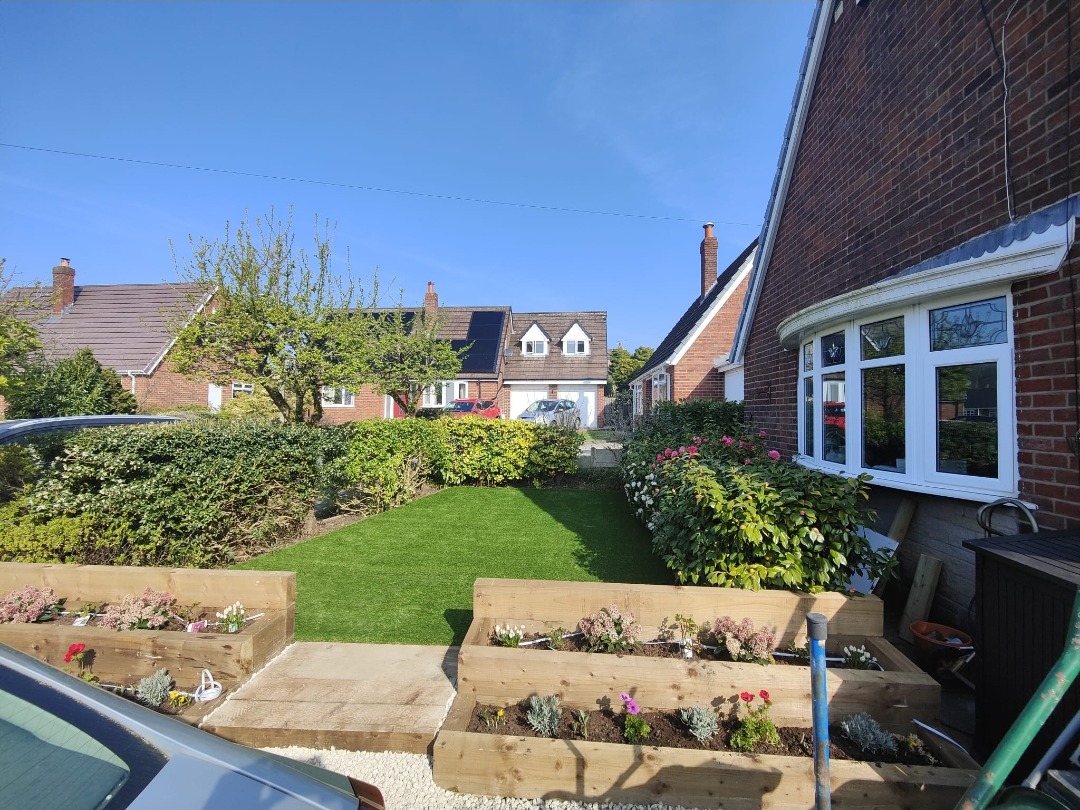
If you’re weighing up a new lawn, the sticker price is only half the story. A real turf lawn looks cheap on day one and an artificial lawn looks expensive — but stretch the sums over a decade and the gap narrows, and for a lot of North West families it flips the other way entirely. This is an honest look at the artificial grass vs real lawn cost question over ten years, using a typical 50m² family garden as our worked example.
The day-one cost: turf wins easily
There’s no getting around it — laying real turf is far cheaper up front. For a 50m² garden you’re typically looking at £20–40 per m² once you’ve paid for the turf itself, topsoil and a bit of ground preparation. Call it £1,500 all in. Artificial grass, properly installed with a compacted sub-base, weed membrane, edging and infill, runs £115–150 per m² — around £6,500 for the same garden. So on day one, real turf is roughly a quarter of the price. If you only ever look at the opening figure, the decision seems obvious.
The costs that creep in with real turf
A living lawn needs feeding. Every single year you’ll spend on the things people forget when they compare prices: petrol or electricity for the mower, feed and weedkiller (£50–100), the odd bag of seed and an aerator or scarifier hire to fix bare patches (around £40), and water during the increasingly dry North West summers if you’re on a meter (£20–50). Do the mowing yourself and the fuel and consumables land somewhere around £200–240 a year. Pay a gardener to keep it tidy and that jumps to £400–800 a year on its own.
Then there’s the cost that never shows up on a receipt: your time. A lawn this size swallows 20–30 hours a year in mowing, edging and general fussing — most of it in the warm months when you’d rather be enjoying the garden than maintaining it.
What artificial grass actually costs to keep
Once it’s down, a quality artificial lawn is close to cost-free. A quick brush to keep the pile upright, a hose-down after the dogs, and a top-up of kiln-dried sand every few years — averaged out, maybe £30 a year. There’s no mowing, no feeding, no watering and no seasonal patch-up. A good system lasts 15–20 years, so the replacement cost sits well outside our ten-year window.
The ten-year totals, side by side
Here’s how it stacks up over a decade for our 50m² garden. The real turf column is split into two realistic scenarios — you doing the work, or paying someone to.
| Cost over 10 years | Real turf (DIY) | Real turf (gardener) | Artificial grass |
|---|---|---|---|
| Initial installation | £1,500 | £1,500 | £6,500 |
| Annual upkeep | ~£220/yr | ~£700/yr | ~£30/yr |
| 10-year upkeep total | £2,200 | £7,000 | £300 |
| 10-year total | £3,700 | £8,500 | £6,800 |
| Your time per year | 20–30 hrs | a few hrs | near zero |
The pattern is clear. If you happily mow your own lawn, real turf stays cheaper on paper across ten years. But the moment you’d pay a gardener — or you put any value on those 20–30 hours a year — the maths tips towards artificial. For a family garden where the lawn gets paid for by a professional, the crossover point where artificial grass pays for itself typically lands somewhere around year six to eight.
The trade-offs that aren’t about money
Cost isn’t the whole picture, and it would be dishonest to pretend otherwise. Real turf is a living surface: it hosts insects and birds, it sequesters a little carbon, it cools the air on a hot day, and at the end of its life it simply breaks down. Artificial grass does none of that — it’s a finish, not an ecosystem, and it can’t be composted when it’s eventually lifted. If wildlife and biodiversity matter to you, a real lawn (or a mixed planting scheme) has a genuine edge. Artificial grass earns its place on drainage, durability, and the sheer convenience of a surface that looks the same in February as it does in July.
Three things to weigh before you decide
- How much is your time worth? If weekends spent mowing feel like a chore, that’s a real cost even if it never hits your bank account.
- Who uses the garden? Kids and dogs turn a real lawn into a muddy patchwork fast — artificial grass shrugs it off and drains straight through.
- What do you value? A living, wildlife-friendly lawn or a pristine, no-effort finish. Both are valid — they’re just different priorities.
Not sure which way the numbers fall for your garden?
Every garden is different — size, access, drainage and how you use the space all move the figures. If you’d like the sums done properly for your own plot, our team offers a free site survey and a fixed-price quote within one working day, so you can compare a real number against your current lawn costs rather than a rough estimate. You can see the range of gardens we’ve transformed across the North West on our previous projects page, and read more about our approach on our artificial grass installation service page.
The bottom line
Over ten years, the artificial grass vs real lawn cost decision is rarely a knockout on price alone — it’s genuinely close, and which side wins depends almost entirely on whether you count your time and who does the mowing. For hands-on gardeners who enjoy the work, real turf keeps its edge. For time-poor families with kids and pets who’d otherwise be paying for upkeep, the maths usually points to artificial. Work out your honest annual upkeep first, then let the ten-year total — not the day-one price tag — make the call.